
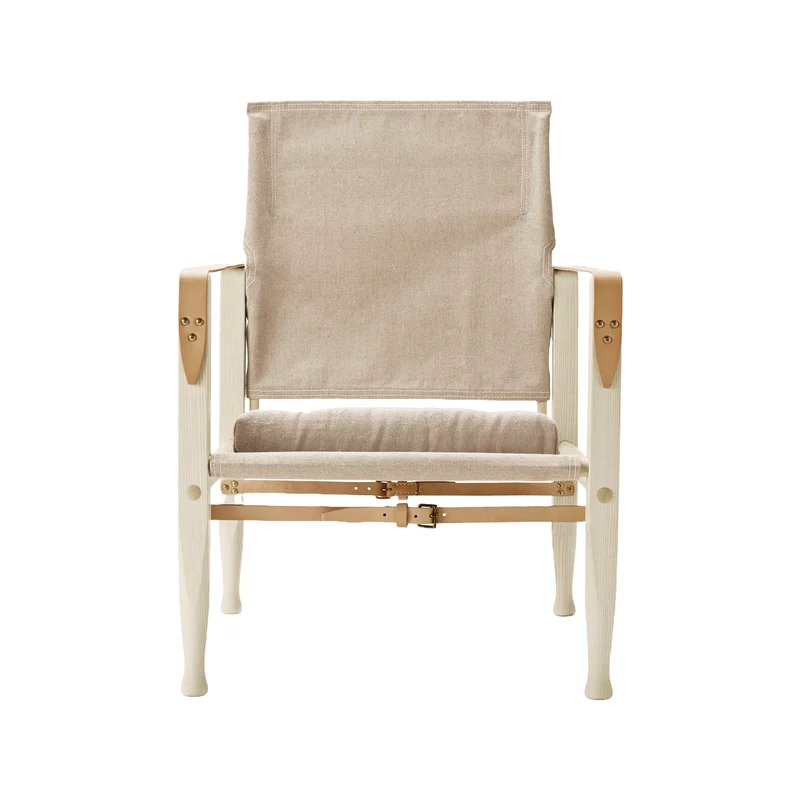
Description
The KK47000 Safari Chair is a refinement of the chairs brought on an African safari by an American cinematographer and his wife. The designer noticed them in the couple’s photos. They were most likely based on Indian Roorkhee Chairs used by the British military – possibly the first examples of self-assembled furniture. The original featured glueless joints, tool-free assembly, and an intelligent construction that caused the joints to tighten when the chair was occupied, enhancing strength and stability. For the KK47000 Safari Chair, the designer focused on simplifying, clarifying and refining the lounge chair’s composition, exhibiting the final Safari Chair design in 1933 at the Copenhagen Cabinetmakers’ Guild Exhibition. While inspired by its British predecessor, the sophisticated, lightweight chair is defined by his signature systematic approach, fine craftsmanship, well-conceived proportions, and remarkable material effects.
The Safari Chair matches with KK97170 footstool.
Replacement cushion, leather straps, back and seat covers also available.
The Safari Chair was designed by renowned furniture designer, educator, and visionary, Kaare Klint. Today, he is recognized as the father of modern Danish design. Klint designed icons like the 1914 Faaborg Chair and the 1933 Safari Chair, as well as the design for the reception room of the Danish Pavilion at the 1929 Barcelona International Exposition. Klint insisted on clear, logical design, clean lines, the best materials, and superb craftsmanship. His influence on future generations of designers and architects is still evident to this day.
Reviews
There are no reviews yet.